BLOG

IMPETUX WITH BIOMEDICAL RESEARCH

IMPETUX WITH BIOMEDICAL RESEARCH

IMPETUX with the Health Care sector:

IMPETUX is collaborating in the Innovation of the Health Care sector with Photonic Technologies Program designed by SECPHO (Southern European Cluster in Photonics & Optics) and ITEMAS ( Medical Technology Innovation Platform)

The first meeting was on the 1st of April. There, we take the opportunity to explain how optical tweezers can become a key tool for biomedical research.

There will be more meetings like that. You will find more information at the Secpho webpage here

Stay tuned.
More news:

Fig. 1

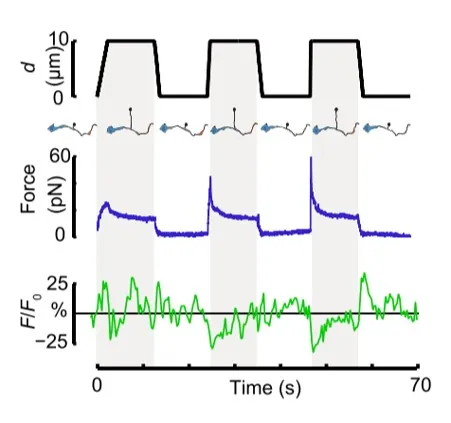
Time dependence of trap position (top), force signal (middle) and Ca2+ fluorescence signal (bottom) recorded during a membrane tether pulling experiment. The force and Ca2+ ion channel activity signals exhibit negative correlation.

Fig. 2

Force and displacement data for two beads stimulated at frequencies of 4 Hz and 0.25 Hz. The progressive reduction of the beads displacement is in concomitancy with an increase of the applied force and loading rate.

Fig. 1

Schematic representation of the optical tweezers experiment. A fibronectin-coated bead is trapped, brought into contact with the cell membrane and stimulated with oscillations at different frequencies.

Fig.2

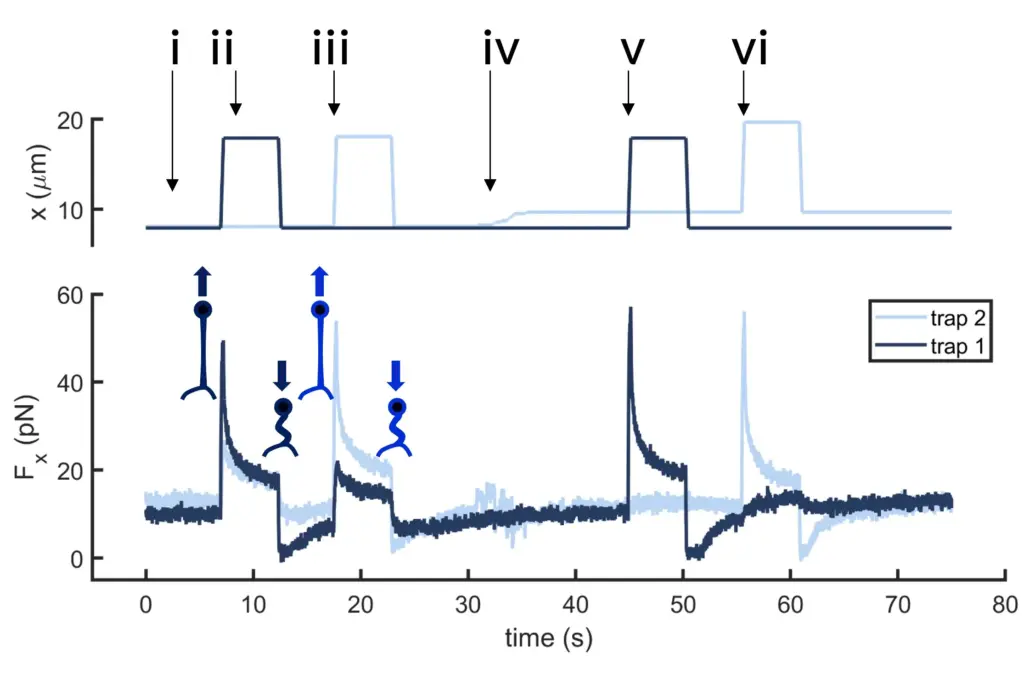
Time dependence of trap 1 and trap 2 position (top) and force (bottom) data along the different steps of the described dual tether pulling experiment.

Fig.1

Confocal video of the described dual tether pulling assay performed on a neuron axon. Courtesy of M. Krieg lab (ICFO).

Fig. 1

Time dependence of trap position (top), force signal (middle) and Ca2+ fluorescence signal (bottom) recorded during a membrane tether pulling experiment. The force and Ca2+ ion channel activity signals exhibit negative correlation.

Video 1

Confocal video showing a DVA neuron Ca2+ ion channel activity in a dynamic optical trapping assay. The pulling rate applied to the membrane tether is progressively increased. Scale bar = 5µm. Acquired at 10Hz.